
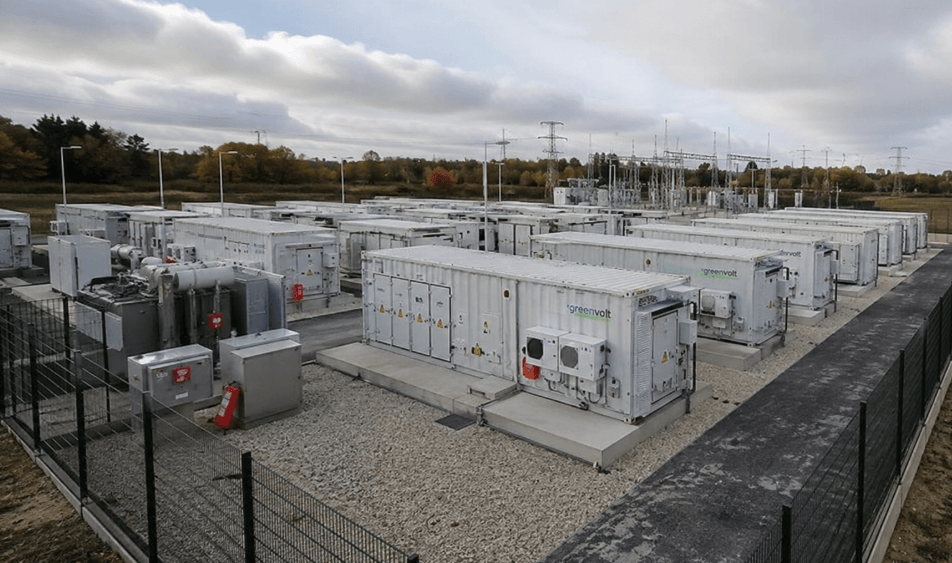
Poland has launched its largest operational battery energy storage system (BESS), a milestone that highlights the country’s growing investment in modernizing its electricity grid and supporting renewable energy. Located in Turośń Kościelna near the city of Białystok in northeastern Poland, the new facility is already contributing to the national power system while completing its final testing phase.
Poland’s Largest Energy Storage Facility Now Online
The new installation has a power capacity of 200 megawatts (MW) and an energy storage capacity of 800 megawatt-hours (MWh), making it the largest operating battery energy storage facility in Poland and one of the largest in Europe, according to Greenvolt Power.
The project represents a significant milestone for Poland’s energy transition, demonstrating how large-scale battery storage is becoming an increasingly important component of the country’s electricity infrastructure.
„Poland is one of the markets where large-scale energy storage has a particularly important role to play, and the investment in Turośń Kościelna strengthens Greenvolt’s position in one of the fastest-growing segments of the energy sector,” said João Manso Neto, CEO of Greenvolt Group.
How the Battery Storage System Supports the Power Grid
Built across more than 8.6 acres (3.5 hectares), the facility connects to Poland’s transmission network through the PSE Narew substation.
Storing Renewable Energy for Peak Demand
The battery system is designed to capture excess electricity generated during periods of high renewable energy production and release that stored power when demand increases. This capability helps stabilize the electric grid while improving the integration of renewable energy sources such as wind and solar.
The facility uses lithium iron phosphate (LFP) battery technology, known for its reliability, safety, and ability to respond rapidly to changing grid conditions.
Its infrastructure includes:
- Containerized battery modules
- Transformer stations
- Power conversion systems
- Advanced battery monitoring technology
- Integrated fire protection systems
- Lightning protection equipment
The installation is capable of delivering electricity at its full 200 MW output for approximately four hours.
Environmental considerations were also incorporated into the design, with more than 70% of the project site remaining biologically active green space.
Built with International and European Components
The project combines equipment sourced from China, Poland, and other European manufacturers. Engineering firm P&Q served as the project’s general contractor, overseeing construction from start to finish.
Greenvolt Expands Battery Storage Projects Across Poland
The Turośń Kościelna facility is only one part of Greenvolt’s expanding portfolio of large-scale energy storage projects in Poland.
Even Larger Projects Already Under Construction
Construction is already underway on a battery storage facility in Siedlce that will feature a planned capacity of 600 MW and 2.4 gigawatt-hours (GWh). Once completed, it is expected to become the largest battery energy storage project in Poland and among the largest in Europe.
At the same time, another project in Ełk is nearing completion with a planned capacity matching the new Turośń Kościelna facility at 200 MW and 800 MWh.
Beginning in 2028, the Turośń Kościelna installation will participate in Poland’s capacity market under a 17-year capacity agreement, providing 170 MW of committed capacity to help maintain grid reliability.
Battery Storage Becoming Essential to Poland’s Energy Transition
Energy industry experts say utility-scale battery storage will play an increasingly important role as Poland expands renewable energy generation and modernizes its electric grid.
Battery storage systems help balance electricity supply and demand, reduce grid congestion, and improve the reliability of power systems that rely more heavily on intermittent renewable energy sources.
Large-Scale Energy Storage Continues to Grow
According to industry data, Poland had approximately 100,000 residential battery storage systems in operation by the end of 2025, and that number continues to increase.
Large-scale battery energy storage systems remain far less common but are expanding rapidly. During 2025, funding was approved for the construction of 172 utility-scale battery storage projects with a combined capacity of approximately 3.9 gigawatts (GW) and 14.5 gigawatt-hours (GWh) of energy storage.
Many of those projects are currently under construction or entering service, while only several dozen utility-scale battery storage facilities are operational nationwide today.
Conclusion
The launch of the Turośń Kościelna battery energy storage facility marks an important step in Poland’s evolving energy strategy. As renewable energy generation continues to grow, projects like this are expected to strengthen grid stability, improve energy reliability, and provide greater flexibility for managing electricity supply across the country.

Henryk Sienkiewicz jest współpracownikiem Appki.com.pl i zajmuje się tematami związanymi z aktualnościami, polityką, biznesem, technologią, sportem, rozrywką oraz stylem życia. Koncentruje się na rzetelnym przekazywaniu informacji, bieżących wydarzeniach i tematach ważnych dla czytelników. Jego artykuły przedstawiają istotne wiadomości i trendy w sposób przejrzysty, zrozumiały i przyjazny dla odbiorców.









Leave a Reply